



By BRIAN SLATTERY | New Haven Independent
Through words, music, and movement, storytellers, drummers, and dancers offered dozens of families a chance to find their place in the legacy of Martin Luther King, Jr., the broader causes of social justice he dedicated his life to, and the rich culture he came out of.
That was all part of the Peabody Museum’s 27th annual celebration of the life of King, held at the New Haven Museum on Sunday and continuing on Monday at the Yale Science Building, all as the Whitney Avenue natural history museum continues to be renovated.

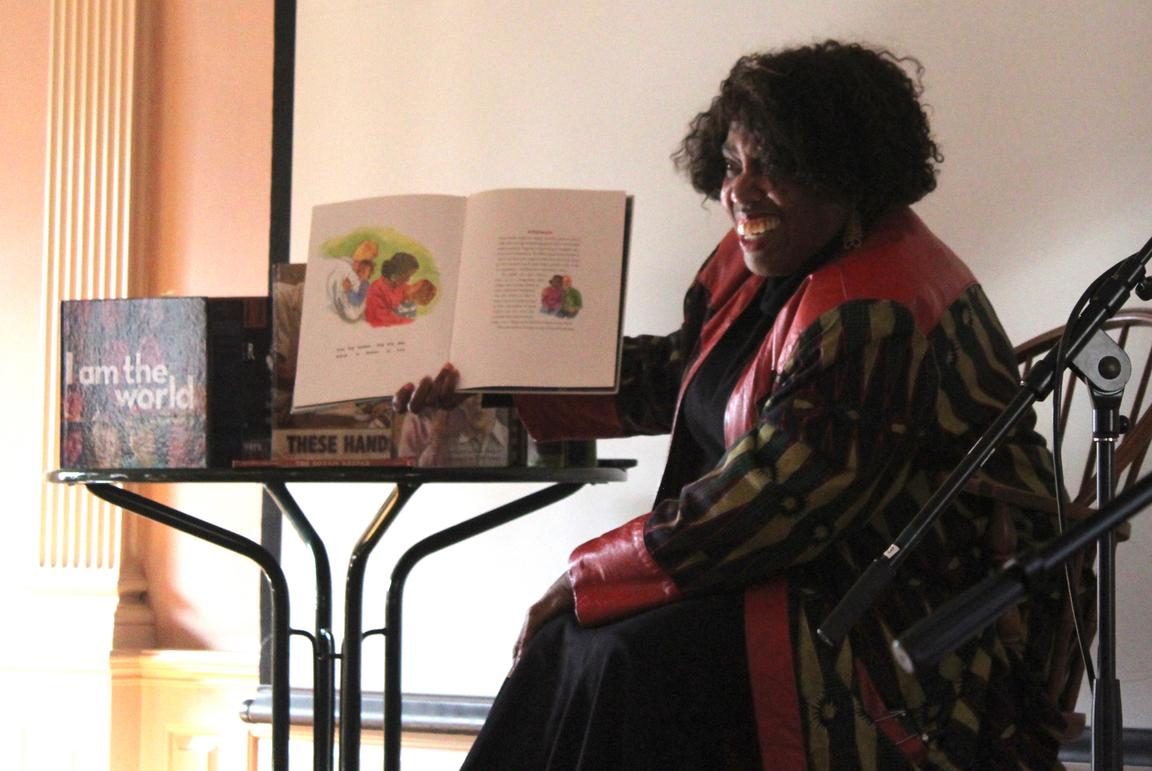
The first storyteller of the day on Sunday was educator Waltrina Kirkland-Mullins, who introduced herself to the crowd before her with a wide smile. “I have not been in this building for the last three years,” she said, expressing her gratitude for being able to celebrate the birthday of Dr. Martin Luther King, Jr. once again in person. Her role as a storyteller gave her a chance, too, to reflect on just how much the United States has progressed along Dr. King’s arc of the moral universe.
“This lady has been on earth for a long time,” she said. “Long enough to know what it is to go to a restaurant and not be served. Long enough to live in a segregated community” — that is, Harlem, where she grew up, which she described as “powerful” and “beautiful,” but segregated nonetheless. “I’m sitting here and thinking about how far America has come since I was a little girl.”
Kirkland-Mullins related how her parents taught her that “everyone was equal” but “it was different when I went outside.” A white child pointed our her Blackness in a department store. Even in New York City in the 1950s, precious few social spaces were integrated. Even though the law didn’t demand it, social custom had Black people ride in the back of public buses anyway. In department stores she noticed that all the people at the sales desk and cash register were white, while the custodial staff were Black.
“Did that happen in the North, too?” she asked. “Dr. King and countless numbers of civil rights activists made it possible for us to interact at an event like this. That’s progress.”
She read Langston Hughes’s poem “Merry-Go-Round,” taking on the absurdities of segregation, adding that she went to an amusement park in New Jersey as a child and was not allowed to ride certain rides. “Could you imagine living like that?” she asked. She then read Arnold Adoff and Emily Arnold McCully’s 1973 book Black Is Brown Is Tan, celebrating interracial families, explaining that “this is a book for all families. Love knows no color.”
Other books, like Margaret H. Mason and Floyd Copoper’s These Hands and Freedom on the Menu, prompted further reflections from Kirkland-Mullins. At diners, “I remember having someone not want to serve us and I would have to wait an hour to get served,” she said. “That happened in New York City, and Pennsylvania, and D.C. It wasn’t just down South.”
“Can you imagine not being able to go places because of the color of your skin?” she asked. “I remember Dr. King making his speeches, and I remember clapping for a long time.” Then, as now, she reacted out of a sense of injustice stemming from a fundamental sense of unfairness that, perhaps ironically, children could often understand better than adults. “Sometimes kids have more common sense than the grown-ups,” she said.