



By MAYA MCFADDEN | New Haven Independent

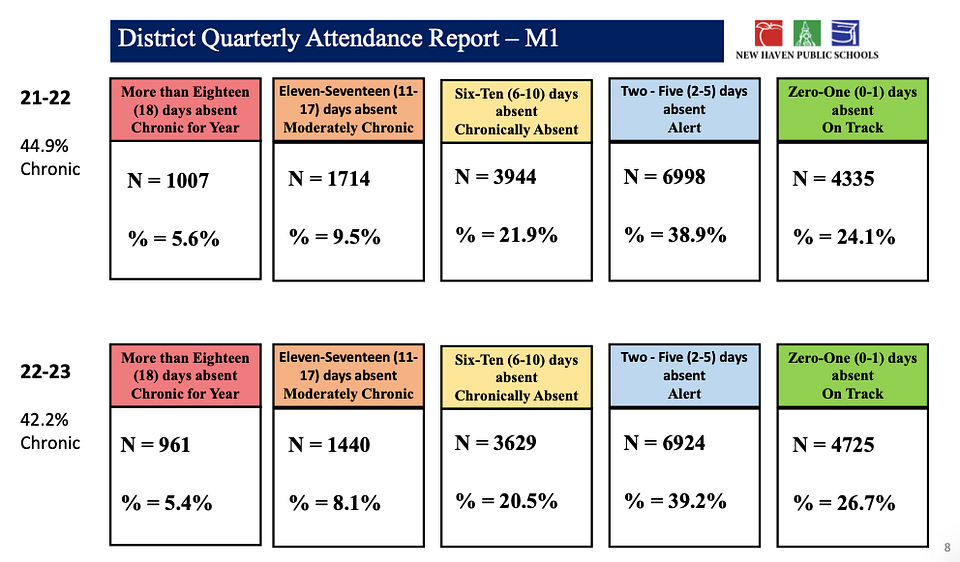
More than four out of every 10 New Haven Public Schools (NHPS) students have missed at least 10 percent of school days so far this academic year — raising questions about why so many young learners are “chronically absent,” and putting a spotlight on what exactly the public school district is doing to make sure kids go to class.
That data — and that ensuing discussion and debate — took center stage Monday night during the latest regular bimonthly Board of Education meeting, which was held online via Zoom.
Ed board members raised concerns about the effectiveness of the district’s intervention process for truancy, as they also asked why so many families are not sending their students to school. (Click here to view the slideshow presentation in full.)
Monday’s presentation by NHPS administrations came on the heels of an Oct. 31 meeting that the city school district officials were called to by the state Department of Education to discuss three years’ worth of NHPS attendance data.
The city defines students as “chronically absent” if they miss 10 percent or more of school days over the course of a 180-day school year. For the first 45-day marking period, more than 42 percent of students so far have missed at least 10 percent of school days since late August.
According to the state’s EdSight data system, NHPS’s end-of-year chronic absenteeism rate has increased significantly during the Covid-19 pandemic.
That chronic absenteeism number was at 19.9 percent for the 2017 – 2018 school year, 19.3 percent in 2018 – 2019, 21.2 percent for 2019 – 2020, 34.4 percent for 2020 – 2021, and a shockingly high 58.1 percent for 2021 – 2022.
NHPS Superintendent Iline Tracey said on Monday that, after looking at the district’s attendance data, state officials expressed “grave concerns for New Haven.”
NHPS Director of Research, Assessment and Evaluation Michele Sherban took the lead Monday night on presenting this school year’s attendance and absenteeism data to date.
She presented on attendance rates for K‑12 city public school students for the first marking period of the school year, which ran from Aug. 28 to Nov. 7 and covered 45 days of school.
According to the city public school system’s definitions, a student is “chronically absent” if they miss at least 10 percent of school days — which translates to more than two school days a month.
“For every individual student, there’s a story to why they’re absent,” Sherban told the ed board members.
She also said that 5.6 percent of NHPS students have already missed at least 18 days of school. That means that they have already passed the threshold of chronically absent for the entire school year, which began at the end of August and ends in June.
“Chronic absenteeism is an urgent and serious matter because absenteeism affects student learning,” NHPS spokesperson Justin Harmon told the Independent in an email comment sent after Monday’s ed board meeting. “We are working hard to boost student achievement in such critical areas as reading and math, and as Dr. Tracey said, You can’t teach an empty seat.”
Why does the district think that so many students are missing so much school this year so far?
“We think there are many reasons for absenteeism,” Harmon replied by email. “There was an uptick in Covid and other respiratory illnesses at the start of the year. Some older students have jobs or family care responsibilities that can cause them to miss time in school. Some are struggling to maintain a sense of engagement in school. There are as many different circumstances as there are students. That’s why we are trying to understand individual students’ stories to help reduce their particular obstacles to attendance. It only takes two days a month to reach the threshold of 10 percent absent, which defines chronic absenteeism.”
And what is the district doing to make sure students actually come to class?
“As we understand and respond to student needs, we are working aggressively to increase mentorship, outreach and home visiting to families, and attendance education,” Harmon wrote, “to expand community partnerships, and to engage our students within our schools. We will be continuously tracking our progress with ongoing data analysis and feedback from our schools, students, families, and community partners throughout the year.”